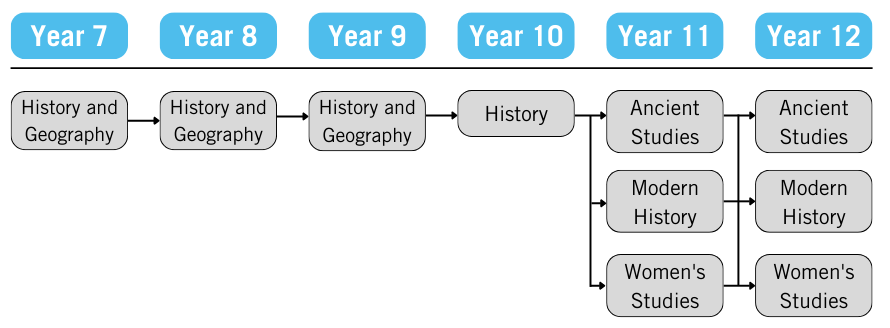
Ancient Studies:
Students explore the literature, history, societies and cultures of a range of ancient communities. With major input of topic choice by students, students study two major societies/cultures such as Ancient Australia, Ancient Egypt, China, Greece, Rome, India, Persia … By exploring social, political, religious, environmental, cultural and economic factors, students look at how societies have changed and the impact this has had on our world. The subject provides invaluable historical context for many of the events happening now as well as, for example, the origins of forms of literature and government. Students interpret and prepare responses in a range of written and/or multi-modal formats for a range of historical questions. They undertake an individual investigation on an area and/or society of personal interest.
Modern History:
Whilst exploring the changes in the world since 1750, students examine development and movements of significance, the ideas that inspired them and their short and long- term consequences on societal systems and individuals. Students are encouraged to be critical thinkers and develop skills in persuasive and informed writing. Students undertake an individual study on a topic of their choice. Other in-depth studies may include revolutions and movements for change. There is scope for students to shape the content of the course and to present work in a range of formats.
Women’s Studies:
Students examine the diversity of women’s experiences and their relationships to others while also investigating how we can promote an inclusive and just society. Students identify complex and contradictory ideas that exist about femininity and masculinity and examine issues in regard to gender and the gender spectrum within society. Students complete two text analysis tasks, one group task and an independent investigation.