Stage 2
For information about SACE Credits, Please see the Welcome to the SACE booklet.
| Compulsory Subjects | SACE Credits |
|---|---|
| Activating Identities and Futures (AIF) – Studied at Stage 1 (year 11) | 10 Credits |
| Subjects | SACE Credits |
|---|---|
| Ancient Studies | 20 Credits |
| Biology | 20 Credits |
| Business Innovation | 20 Credits |
| Chemistry | 20 Credits |
| Child Studies | 20 Credits |
| Dance | 20 Credits |
| Digital Media | 20 Credits |
| Drama | 20 Credits |
| English | 20 Credits |
| English as an Additional Language | 20 Credits |
| English Literary Studies | 20 Credits |
| Essential English | 20 Credits |
| Essential Mathematics | 20 Credits |
| Food and Hospitality | 20 Credits |
| French (continuers) | 20 Credits |
| General Mathematics | 20 Credits |
| Health | 20 Credits |
| Italian (continuers) – dependent on availability | 20 Credits |
| >Legal Studies | 20 Credits |
| Mathematical Methods | 20 Credits |
| Music | 20 Credits |
| Modern History | 20 Credits |
| Nutrition | 20 Credits |
| Physical Education | 20 Credits |
| Physics | 20 Credits |
| Psychology | 20 Credits |
| Scientific Studies | 20 Credits |
| Specialist Mathematics | 20 Credits |
| Technologies and Engineering | 20 Credits |
| Visual Arts – Art | 20 Credits |
| Visual Arts – Design | 20 Credits |
| Women’s Studies | 20 Credits |
Stage 2 - Subjects
All students must study subjects from the list shown below:
English and EAL
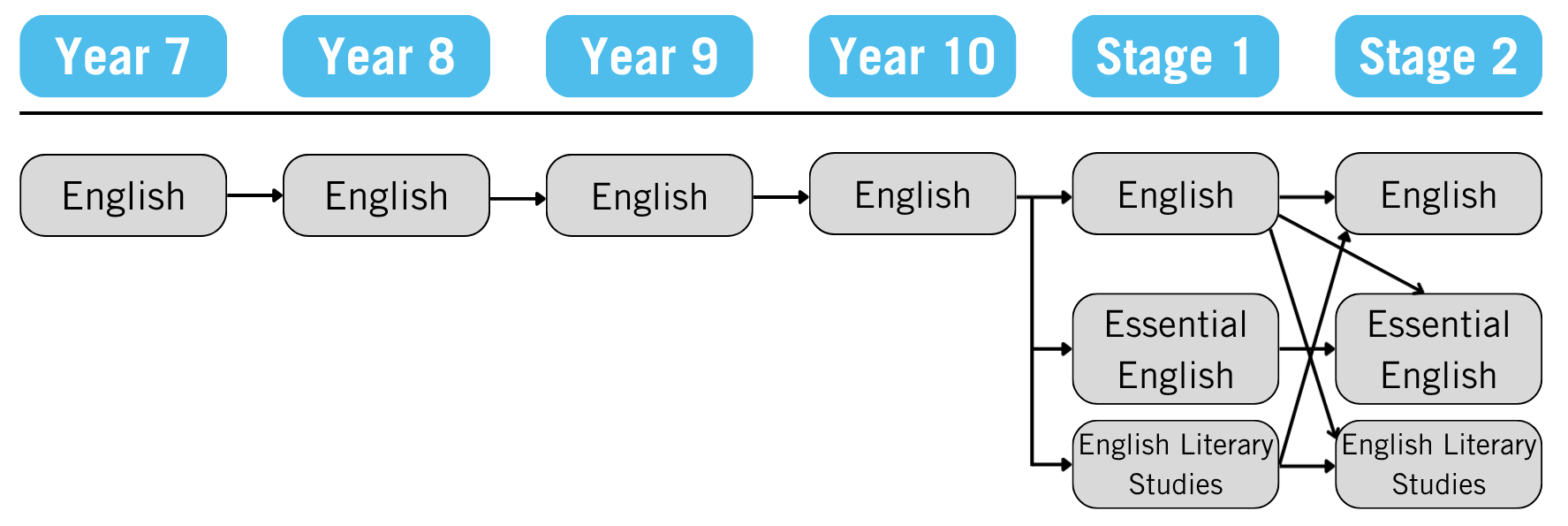
English
- Year Level: Stage 2
Description
In Stage 2 English students engage with a range of texts, such as a class novel, media texts and film/television. They explore the interrelationship of author, text, and audience, with an emphasis on how language and stylistic features shape ideas and perspectives in a range of contexts.
An understanding of purpose, audience, and context is applied in students’ creation of imaginative, interpretive, analytical, and persuasive texts that may be written, oral, and/or multimodal.
There are six school-based assessments: a film response, a novel response, a mass media comparison, a narrative/transformational text, a digital media text and a writer’s statement. The external assessment is a comparative analysis.
The following assessment types enable students to demonstrate their learning in Stage 2 English:
School assessment (70%):
- Assessment Type 1: Responding to Texts (30%)
- Assessment Type 2: Creating Texts (40%)
External assessment (30%):
- Assessment Type 3: Comparative Analysis (30%)
English as an Additional Language (EAL)
- Year Level: Stage 1-2
Description
SACE EAL subjects focus on the development and use of skills and strategies in communication, comprehension, research, language and text analysis, and text creation. Students explore information, opinions and experiences through writing and speaking in a range of contexts. Students analyse personal, social and cultural perspectives presented in texts.
Both Stage 1 and 2 EAL are available to students who speak English as an additional language (EAL), and whose knowledge of the English language is classified as restricted based on the SACE eligibility criteria.
Stage 1 EAL
Evidence of learning is provided by:
- Responding to texts
- Interactive Study
- Language Study
Stage 2 EAL
Evidence of learning is provided by:
- Academic Literacy Study (30%)
- Responses to Texts (40%)
- Examination (30%) (Externally Assessed)
English as an Additional Language (EAL)
- Year Level: Stage 2
Description
SACE EAL subjects focus on the development and use of skills and strategies in communication, comprehension, research, language and text analysis, and text creation. Students explore information, opinions and experiences through writing and speaking in a range of contexts. Students analyse personal, social and cultural perspectives presented in texts.
Both Stage 1 and 2 EAL are available to students who speak English as an additional language (EAL), and whose knowledge of the English language is classified as restricted based on the SACE eligibility criteria.
Stage 1 EAL
Evidence of learning is provided by:
- Responding to texts
- Interactive Study
- Language Study
Stage 2 EAL
Evidence of learning is provided by:
- Academic Literacy Study (30%)
- Responses to Texts (40%)
- Examination (30%) (Externally Assessed)
English Literary Studies
- Year Level: Stage 2
Description
In Stage 2 English Literary Studies, students primarily focus on developing the skills and strategies of critical reading and analysis needed to interpret texts. They study ways in which literary texts – novels, poetry, film, drama – represent culture and identity, and the dynamic relationship between authors, texts, audiences, and contexts.
Students produce responses that show the depth and clarity of their understanding, and their critical thinking. By focusing on the creativity and craft of authors, students develop strategies to enhance their own skills in creating texts.
There are six school-based assessments: a novel response, a film response, a critical perspectives task, a poetry comparison, a transformative text and writer’s statement, and a persuasive text. This course includes an externally assessed comparative analysis and a critical reading e-exam.
The following assessment types enable students to demonstrate their learning in Stage 2 English Literary Studies:
School assessment (70%):
- Assessment Type 1: Responding to Texts (50%)
- Assessment Type 2: Creating Texts (20%)
External assessment (30%):
Assessment Type 3: Text Study:
- Part A: Comparative Text Study (15%)
- Part B: Critical Reading Exam (15%)
Essential English
- Year Level: Stage 2
Description
In Stage 2 Essential English, students respond to and create texts in and for a range of personal, social and cultural contexts. Students understand and interpret information, ideas, and perspectives in texts and consider ways in which language choices are used to create meaning.
Students respond to an analysis of a website, a film, and reality television. They also have the opportunity to create a range of texts using written, oral and multimodal formats.
There are six school-based assessment tasks, which include written analysis, an advocacy speech, a restaurant review and an instructional video. The external assessment is a language study.
The following assessment types enable students to demonstrate their learning in Stage 2 Essential English:
School assessment (70%):
- Assessment Type 1: Responding to Texts (30%)
- Assessment Type 2: Creating Texts (40%)
External assessment (30%):
- Assessment Type 3: Language Study (30%)

HASS
HASS
- Year Level: Stage 2
Description
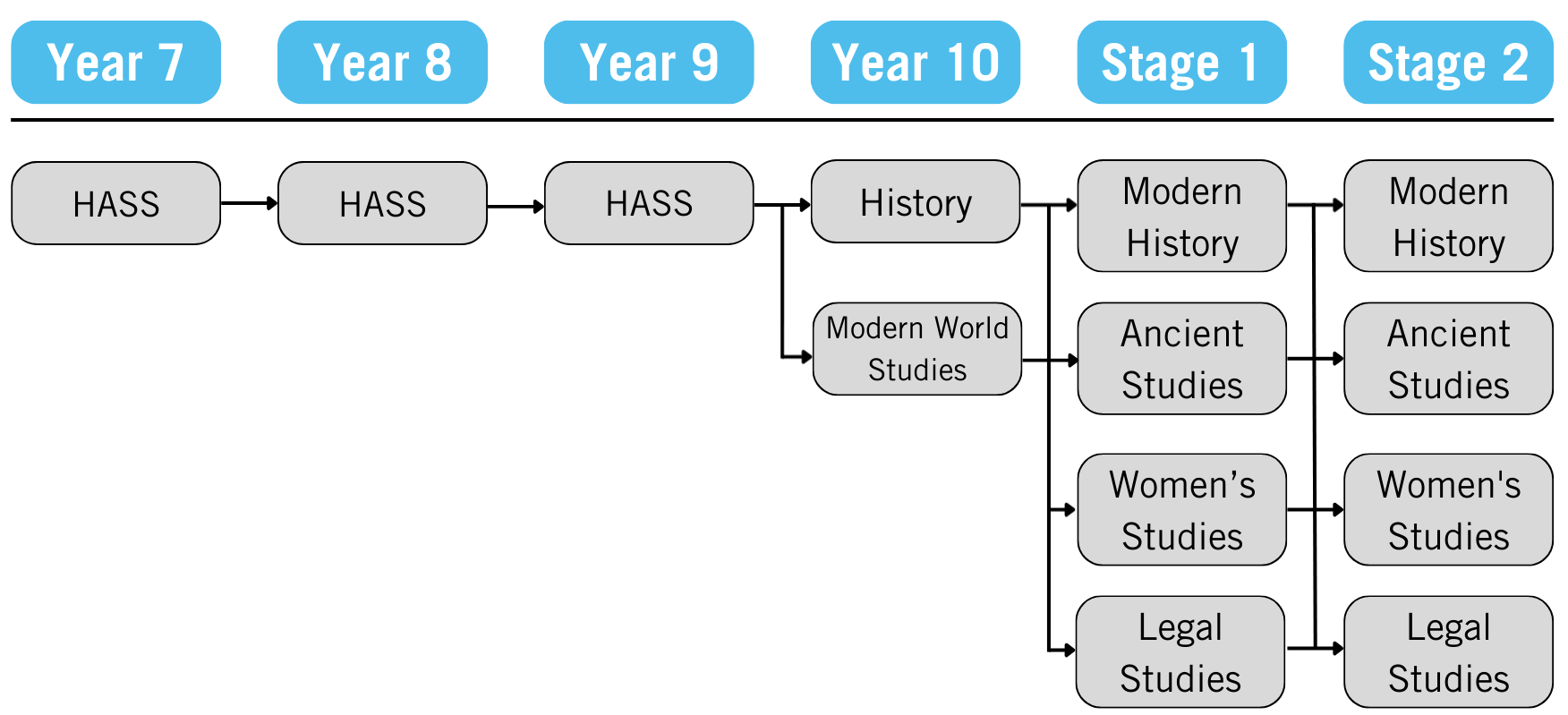
Ancient Studies:
Students learn about ancient societies through the lens of historical, political, religious, cultural and literary perspectives. The course can build on learning which occurs in stage 1 and there can be a stronger focus on literature (such as drama) and/or the roles of different social groups in societies (slaves, foreigners, citizens). There is no external examination in the subject
The first assessment component (50%) focuses on skills and applications where students complete four tasks. In the second section (20%) students undertake two tasks, addressing connections between people and places. Students are encouraged to use a range of formats in responses, such as written, oral and multimodal.
The externally moderated component for this course is an independent research essay (30%) done at school, where students focus on an area of personal interest within the course. Some topics chosen by students can make very strong connections to current times and issues.
Modern History:
Students investigate change in the twentieth century, firstly engaging in a study of one country in ‘Modern Nations’ and of interactions between or among nations in ‘The world since 1945’. (including a topic called challenges to peace and security) Through their studies, students build their skills in historical method through inquiry. The school assessment component consists of two assessment types: Historical Skills (50%) where students complete five tasks and an Independent Historical Study (20%) of 2,000 words or equivalent (such as a multimodal presentation) in which students independently investigate an aspect of the world since c.1750. Modern History includes a 130-minute on-line electronic examination (30%) that is divided into two sections: an essay and a source analysis.
Women’s Studies:
Stage 2 Womens Studies provides students with the opportunity to undertake in- depth studies applying knowledge and understanding of the meaning of gender and its construction. As such they undertake a series of interrelated tasks examining the issues of disempowerment and empowerment based on three themed topics. Students also can explore in detail one of the eleven broad topic areas through an individual investigation as well as complete a set of gender analysis tasks on two additional areas of study. All students will communicate informed ideas about the diversity of women’s experiences, using the language of gender analysis.
Legal Studies:
Law is intended to facilitate fairness, justice, and harmony within communities. Legal Studies enables an understanding of the operation of the Australian legal system, its principles and processes, and prepares students to be informed and articulate in matters of the law and society.
Central to Legal Studies is an exploration of the competing tensions that arise between rights and responsibilities, fairness and efficiency, the empowered and the disempowered, and certainty and flexibility. Laws must constantly evolve in order to resolve these tensions, while also responding to changes in community values and circumstances.
Legal Studies is explored through the mechanism of asking ‘big questions’. Big questions stimulate deep thinking and engagement, and the consideration of a range of perspectives. Students must develop an argument in response to these questions, by evaluating, analysing and applying contextually appropriate legal principles, processes, evidence, and cases. Students consider a range of perspectives to make recommendations for reforms to the legal system and laws.
Students explore rights and responsibilities, sources of law, and adversarial and inquisitorial dispute resolution processes. Through Legal Studies, students examine how people, governments and institutions shape the law and how law controls, shapes, and regulates interactions between people, institutions, and government. Students develop an understanding of the ways in which they can influence democratic processes, the importance of critical and conceptual thinking, and the significance of checks and balances in providing lawful mechanisms to control the exercise of power.
Legal Studies empowers students to evaluate evidence in order to make decisions and potentially substantiated recommendations about legal principles and processes. Conceptual understanding and analysis allow transference within and across disciplines and for future learning. This skill development enables students to approach new situations and contexts with an analytical and problem-solving mindset.
The capabilities are deeply embedded in the nature of thinking, learning, and engagement with others.
Health & PE
Activating Identities and Futures (AIF)
- Year Level: Stage 2
Description
The purpose of Activating Identities and Futures is for students to take greater ownership and agency over their learning (learning how to learn) as they select relevant strategies (knowing what to do when you don’t know what to do) to explore, create and/or plan to progress an area of personal interest towards a learning output.
Students explore ideas related to an area of personal interest through a process of self-directed inquiry. They draw on knowledge, skills and capabilities developed throughout their education that they can apply in this new context and select relevant strategies to progress the learning to a resolution. The focus of the exploration aims to develop capabilities and support students in their chosen pathways.
School assessment:
- Assessment Type 1: Portfolio (35%)
- Assessment Type 2: Progress Checks (35%)
External assessment:
- Assessment Type 3: Appraisal (30%)
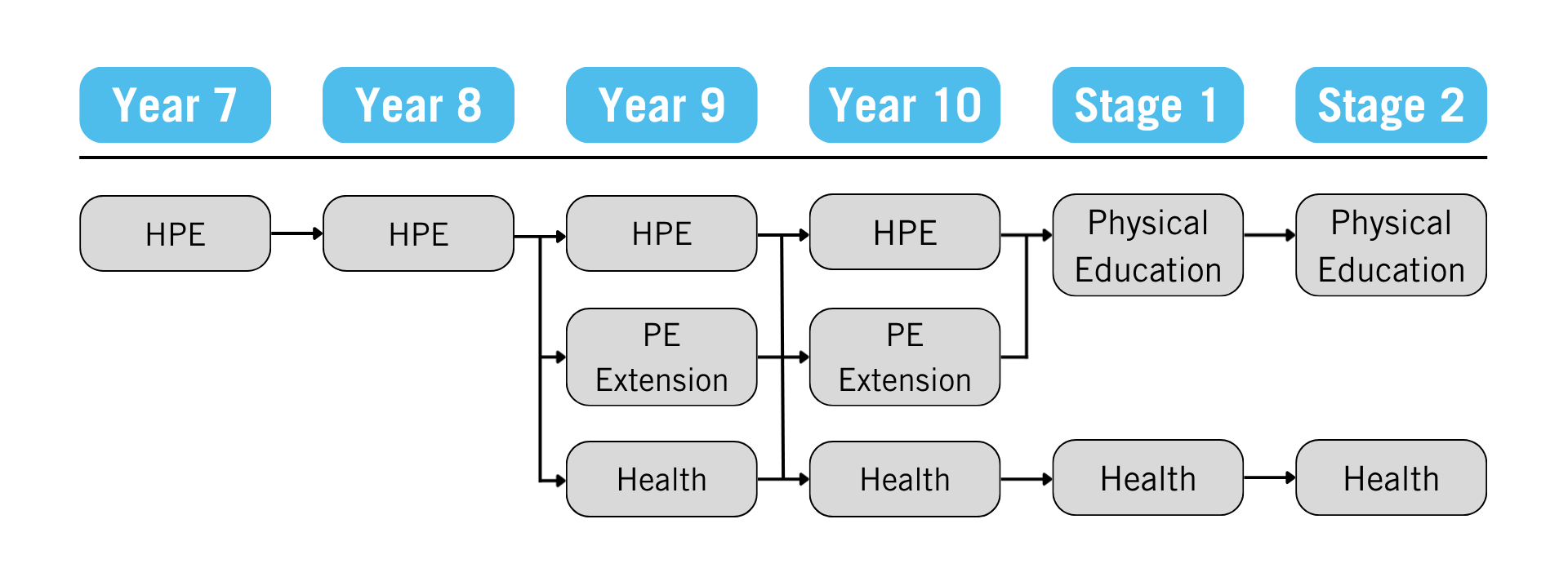
Health and Wellbeing
- Year Level: Stage 2
Description
Students develop the knowledge, skills, and understandings required to explore and analyse influences and make informed decisions regarding health and wellbeing. They consider the role of health and wellbeing in various contexts and explore ways of promoting positive outcomes for individuals, communities, and global society. Key focus areas students investigate include:
- Health Promotion in the Community
- Current health trends and issues
- Health and Environment
- Health and Relationships
Risks and Challenges to Health Evidence of learning is assessed through:
- Initiative (Individual Practical Initiative and Group Investigation and Presentation)
- Folio (Global Health task and Issues Analysis)
- Inquiry
Physical Education
- Year Level: Stage 2
Description
Through Physical Education, students explore the participation in and performance of human physical activities. It is an experiential subject in which students explore their physical capacities and investigate the factors that influence and improve participation and performance outcomes, which lead to greater movement confidence and competence. Evidence of learning is demonstrated through:
- Assessment Type 1: Diagnostics – weighting 30%
- Assessment Type 2: Improvement Analysis – weighting 40%
- Assessment Type 3: Group Dynamics – weighting 30%
Languages
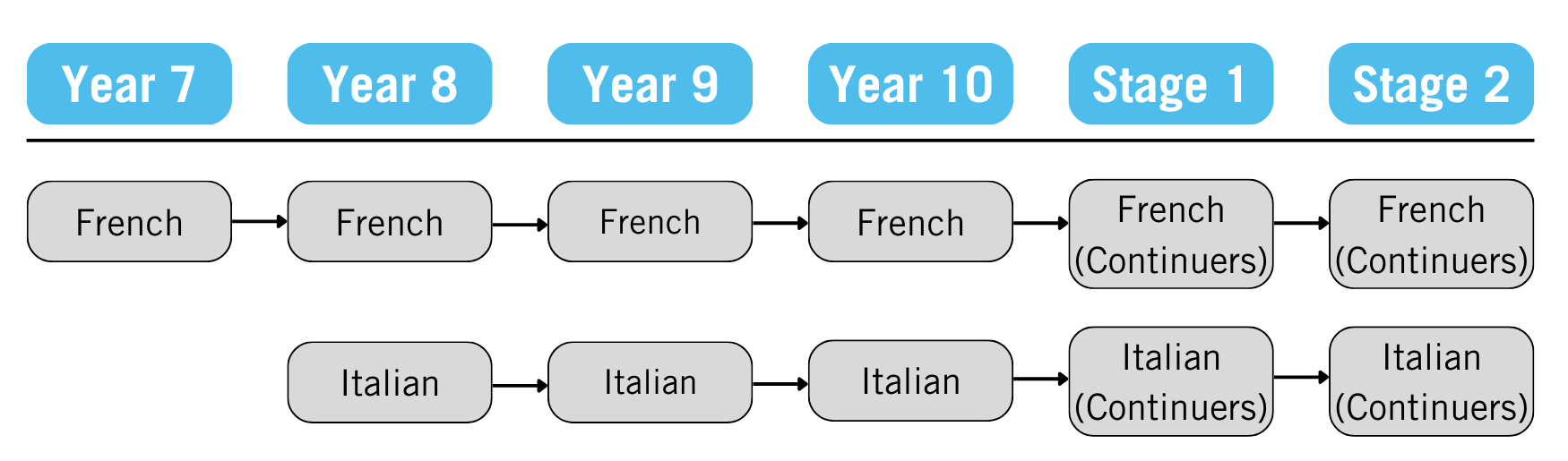
Languages: French or Italian
- Year Level: Stage 2
Description
Students undertake a course of learning designed to enable them to use their target language fluently, accurately and appropriately in communication with others. This course is designed for students who have undertaken between 400–500 hours of study in their language of choice by the end of Stage 2. Students study three themed-focus areas of study with several sub-topics and prescribed topics. Students are required to undertake an individual in-depth study in an area connected with the culture, history, geography or lifestyle of their target language communities. Each course currently has a compulsory written external examination which is conducted in an on-line (electronic) format, as well as an oral external examination. Once combined, they are worth 30% of the subject grade.
Mathematics
Mathematics
- Year Level: Stage 2
Description
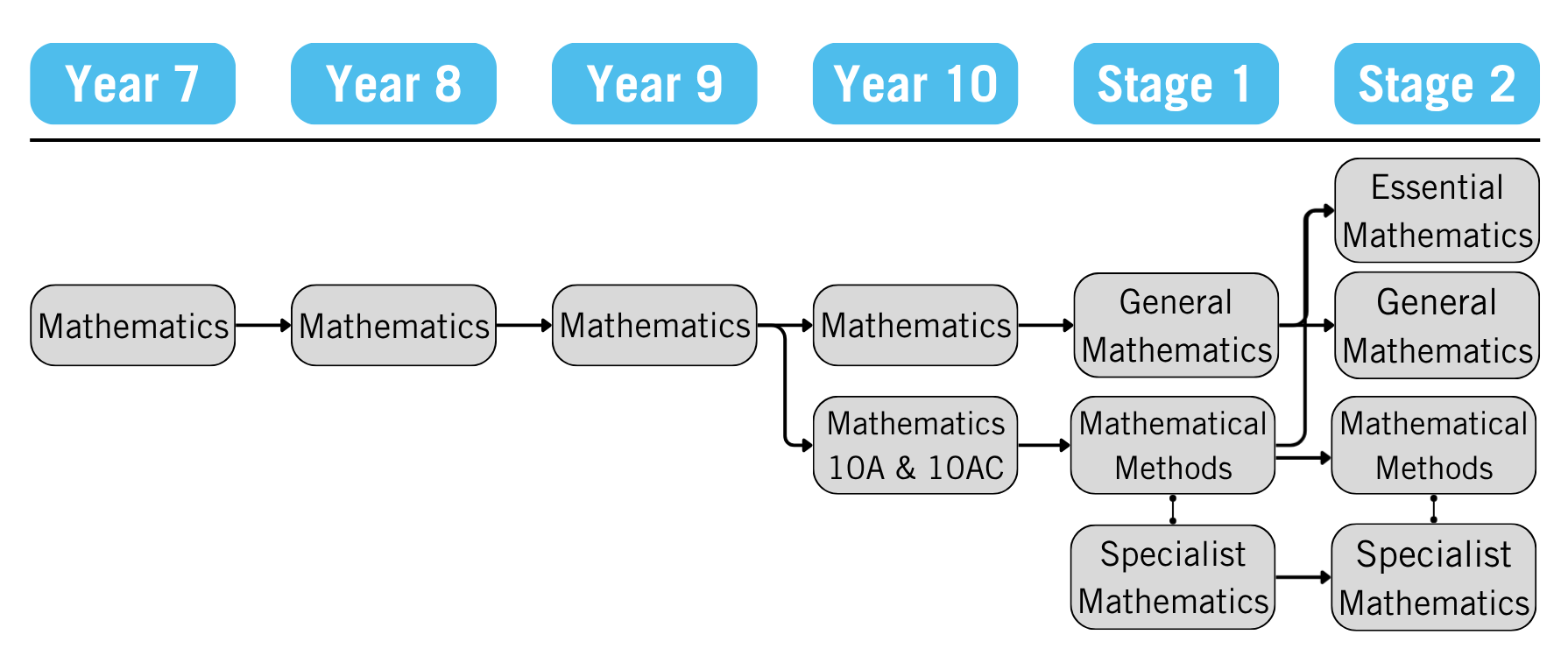
Essential Mathematics:
Essential Mathematics offers senior secondary students the opportunity to extend their mathematical skills in ways that apply to practical problem-solving in everyday and workplace contexts. Students apply their mathematics to diverse settings, including everyday calculations, financial management, business applications, measurement and geometry, and statistics in social contexts. In Essential Mathematics there is an emphasis on developing students’ computational skills and expanding their ability to apply their mathematical skills in flexible and resourceful ways.
General Mathematics:
Students study a variety of modelling techniques with a focus on solving routine and complex real-life problems. Assessment includes a project requiring students to investigate financial models in the context of home loans and superannuation. This course will be of interest to any student wanting to build strong foundational maths skills. The content is directly applicable to project management, business and statistical analysis. Students who have completed a full year of Year 10 and Year 11 Mathematics (General or Methods) will have skills to be successful in this course.
Mathematical Methods:
Mathematical Methods develops an increasingly complex and sophisticated understanding of calculus and statistics. By using functions and their derivatives and integrals, and mathematically modelling physical processes, students develop a deep understanding of the physical world through a sound knowledge of relationships involving rates of change.
Specialist Mathematics:
Specialist Mathematics is to be studied in conjunction with Mathematical Methods. It draws on and deepens students’ mathematical knowledge, skills, and understanding, and provides opportunities for students to develop their skills in using rigorous mathematical arguments and proofs using mathematical models. It includes the study of functions and calculus. The subject leads to study in a range of tertiary courses such as mathematical sciences, engineering, computer science and physical sciences.
Science
Biology
- Year Level: Stage 1-2
Description
Stage 2 Biology students learn about organisms and their surroundings. They look at the chemicals used and built within the cells and the functions and types of cells in complex multicellular organisms. Students then look at how these cells work together in systems within an organism, finishing with how organisms have evolved and adapted to their changing environments, or died out in the process.
Students plan and execute biological investigations, collecting evidence on topics such as:
- DNA and Proteins
- Cells – Structures and Functions
- Homeostasis
- Evolution.
Chemistry
- Year Level: Stage 1-2
Description
Students study matter that makes up materials and the properties, uses, means of production and reactions of these materials. The course includes a critical study of the social and environmental impact of materials and chemical processes. Students consider how human beings make use of the Earth’s resources and the impact of human activity on the environment. Through practical studies, students develop investigation skills and an understanding of the physical world that enables them to be questioning, reflective and critical thinkers.
This full year practical-based subject introduces students to the concepts of Chemistry through a study of the following topics:
- Bonding
- Chemical Reactions
- Materials
- Stoichiometry
- Organics
- Electrochemistry
- Polymers
Stage 2 Chemistry is organised so that each intended student learning outcome is related to a key chemical idea or concept within topics. Through the study of these key ideas and concepts, students develop their chemistry investigation skills.
Topics:
- Monitoring the Environment
- Managing Chemical Processes
- Organic and Biological Chemistry > Managing Resources
Nutrition
- Year Level: Stage 2
Description
Nutrition is a science which immerses students in the fundamentals of human nutrition, physiology and health and promotes investigation of current and emerging trends. It is the study of dietary, lifestyle, and healthy eating patterns with specific focus on nutrients in food, how the body uses nutrients, and the relationship between diet, health, and disease. Students apply knowledge and understanding of nutrition to conduct investigations and examine scenarios.
Students use technologies, scientific evidence, and research to critically analyse information and make informed decisions or recommendations. Students consider how the food and nutrition needs of different population demographics are affected by food availability and product development. Students develop an understanding of the need to evaluate food systems and food quality standards, marketing of food, food availability, and cultural influences on food selection. Through this understanding, students develop their personal and social capabilities, and ethical and intercultural understanding. Students explore the link between food systems, environmental impacts, climate change, and food sustainability. They suggest solutions to complex issues, informed by current research and Australian consumer-protection practices.
Students have opportunities to investigate contemporary issues of global and local food trends, advances in technology, and the development of new foods and food packaging. These issues will affect the future health and nutrition of populations.
This subject incurs an additional subject levy. In 2024 the fee was $120 per year but this may be subject to change in 2025.
Physics
- Year Level: Stage 1-2
Description
Students have opportunities to understand and appreciate the natural world. As well as applying knowledge to solve problems, students develop skills in experimentation, investigation design, collection of information and communication through practical and other learning activities. Students gather evidence from experiments and acquire new knowledge through their own investigations and research.
In this full year SACE Stage 1 course, students further develop their understanding of interactions that occur in the universe through the following topics:
- Motion
- Sound and Light
- Force
- Nuclear Physics
- Electromagnetism
- Energy
Stage 2 Physics requires the interpretation of physical phenomena through a study of motion, electricity and magnetism, and light and matter.
As well as applying knowledge to solve problems, students develop skills in experimentation, investigation design, collection of information and communication through practical and other learning activities.
Physics
- Year Level: Stage 2
Description
Students have opportunities to understand and appreciate the natural world. As well as applying knowledge to solve problems, students develop skills in experimentation, investigation design, collection of information and communication through practical and other learning activities. Students gather evidence from experiments and acquire new knowledge through their own investigations and research.
In this full year SACE Stage 1 course, students further develop their understanding of interactions that occur in the universe through the following topics:
- Motion
- Sound and Light
- Force
- Nuclear Physics
- Electromagnetism
- Energy
Stage 2 Physics requires the interpretation of physical phenomena through a study of motion, electricity and magnetism, and light and matter.
As well as applying knowledge to solve problems, students develop skills in experimentation, investigation design, collection of information and communication through practical and other learning activities.
Psychology
- Year Level: Stage 1-2
Description
Students are enabled to understand their own behaviours and the behaviours of others, as it has direct relevance to their personal lives. Psychological knowledge can be applied to improve outcomes and the quality of experience in various areas of life, such as education, relationships, child rearing, employment and leisure.
Psychology builds on the scientific method by involving students in the collection and analysis of data. By emphasising evidence- based procedures (i.e. observation, experimentation and experience) students develop useful skills in analytical and critical thinking and in making inferences.
In SACE Stage 1, students study:
- Cognitive Psychology
- Neuropsychology
- Lifespan Psychology
- Exercise and Sports Psychology
- Psychological Wellbeing
- Psychology in Context
In SACE Stage 2, topics include:
- Psychology of the Individual
- Psychological Health and Wellbeing
- Organizational Psychology
- Social Influence
- The Psychology of Learning
Psychology
- Year Level: Stage 2
Description
Students are enabled to understand their own behaviours and the behaviours of others, as it has direct relevance to their personal lives. Psychological knowledge can be applied to improve outcomes and the quality of experience in various areas of life, such as education, relationships, child rearing, employment and leisure.
Psychology builds on the scientific method by involving students in the collection and analysis of data. By emphasising evidence- based procedures (i.e. observation, experimentation and experience) students develop useful skills in analytical and critical thinking and in making inferences.
In SACE Stage 1, students study:
- Cognitive Psychology
- Neuropsychology
- Lifespan Psychology
- Exercise and Sports Psychology
- Psychological Wellbeing
- Psychology in Context
In SACE Stage 2, topics include:
- Psychology of the Individual
- Psychological Health and Wellbeing
- Organizational Psychology
- Social Influence
- The Psychology of Learning
Scientific Studies
- Year Level: Stage 2
Description
Students develop the skills and abilities to explain scientific phenomena, and to draw evidence-based conclusions from the investigation of science-related issues. In this way, students develop scientific knowledge and skills to support them in their future, including career pathways that are science-related, and everyday life in a world shaped by science and technology.
Students investigate at least one issue in science of personal, social or environmental relevance. They learn to pose questions about the world around them. They use their observations and gather data and information to generate evidence and test scientific claims.
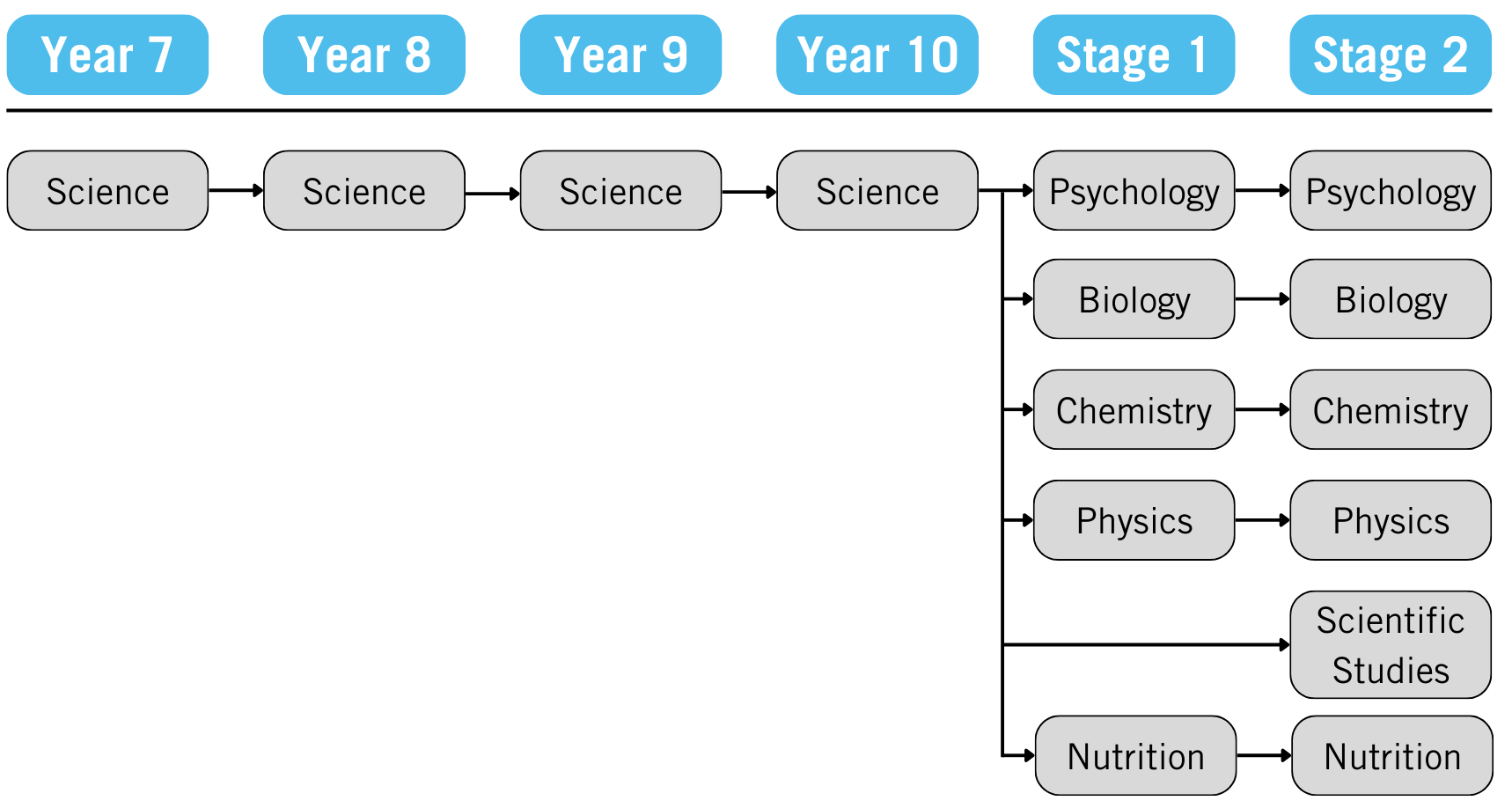
Students have the opportunity to investigate areas of interest and are involved within the design process of the program. Through this, they are able to access the science of their choosing (physics, biology, psychology, chemistry, nutrition).
Topics studied may include:
- Forensic Science
- Microbes
- Consumer Science
- Water Ecology
- Animal Conservation
Students also choose their own investigation based on one of the four main areas of science they’re interested in (physics, chemistry, biology, psychology, nutrition).
Technologies
Technologies
- Year Level: Stage 2
Description
Technologies & Engineering:
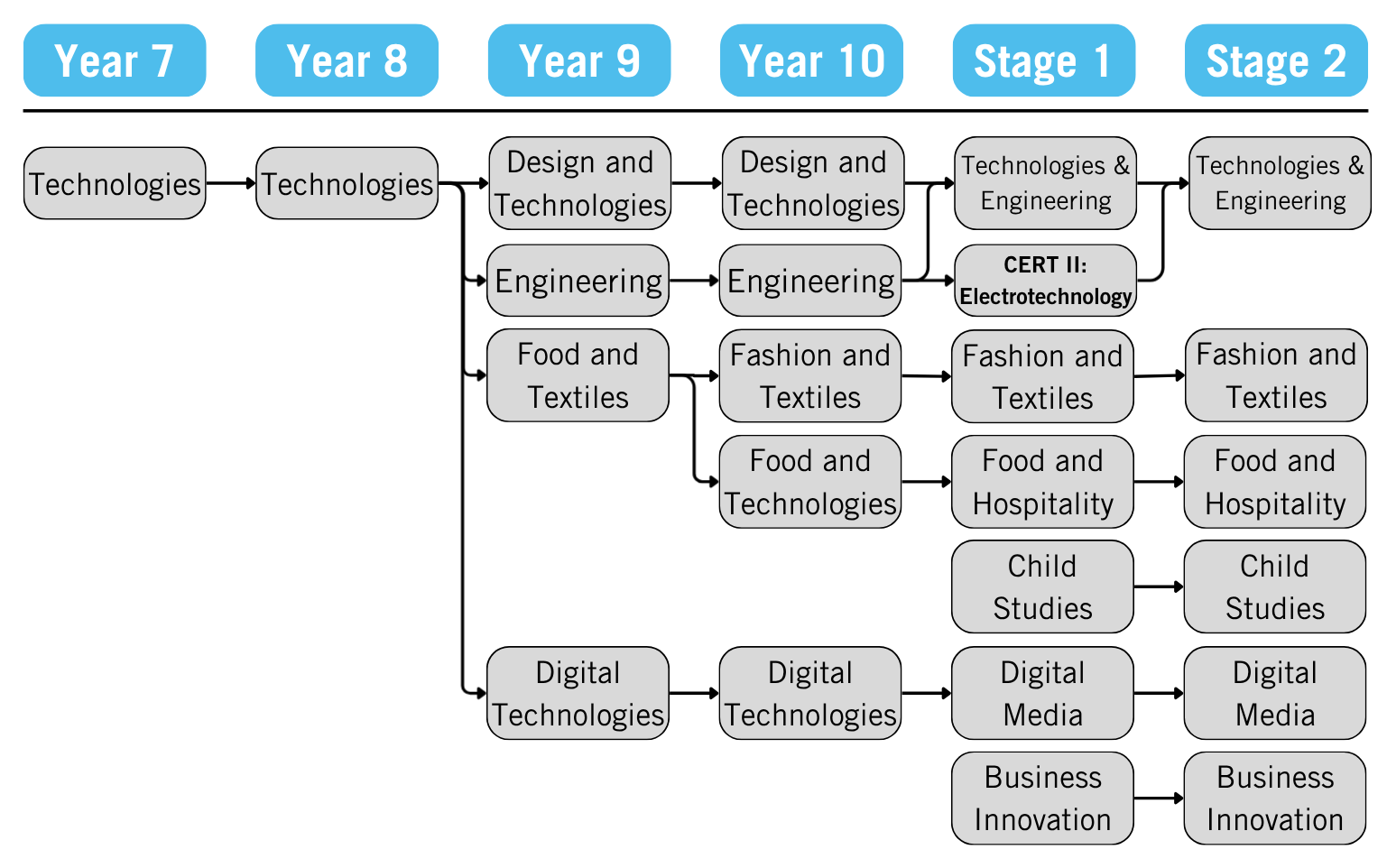
Technologies & Engineering provides a pathway for students who have studied Stage 1 Technologies and Engineering and Cert II Electrotechnology. Students investigate a range of existing products, systems and materials, then develop their own projects that meet a specific design brief. Major projects can range from product design, robotics, metal fabrication, electrical and electronics engineering, furniture design and construction. This course runs under the SACE subject Design, Technology and Engineering – Industry and Entrepreneurial Solutions (2IES20)
Fashion & Textiles:
Fashion & Textiles provides a pathway for students who have studied Stage 1 Fashion and Textiles. Students investigate a range of existing designs and textiles materials that will inform the development of their own textiles’ items. Students then use a range of skills and production techniques including the use of hand tools, sewing machines, vinyl cutter, heat press and other equipment required to design and make their chosen garments. This course runs under the SACE subject Design, Technology and Engineering – Material Solutions (2MRS20)
Food & Hospitality:
This course provides opportunities to plan, prepare and cater for a range of school events and functions. The students develop skills and safe work practices in the preparation, storage and handling of food, complying with current health and safety legislation. Students focus on the impact of the food and hospitality industry and examine the contemporary and changing nature of the industry. Students will further develop relevant knowledge and skills as consumers and industry workers.
This subject incurs an additional subject levy. In 2025 the fee was $120 per year but this may be subject to change in 2026.
Child Studies:
Child Studies focuses on children and their development from conception to 8 years. Students explore concepts such as the development, needs, and rights of children, the value of play, concepts of childhood and families, and the roles of parents and care-givers. Students investigate contemporary issues that are relevant to children and their development.
Child Studies is a practical subject informed by theory, and students have the opportunity to develop knowledge and understanding of young children through individual, collaborative, and practical learning. This subject suits those interested in a career working with children, and anyone who enjoys working with our youngest members of our community.
Digital Media:
This course provides a pathway for students who have studied Stage 1 Digital Media. Students can choose either photography, graphic design, web-design, film or multi-media as the context for their major project. They select the most relevant and appropriate techniques to effectively communicate their projects. Students have the option to produce a range of different media products using industry standard software. This course runs under the SACE subject Design, Technology and Engineering – Digital Communication Solutions (2DCS20)
Please note: from the 3 courses above, you can only select 2 that contribute to an ATAR score. Only a maximum of 40 Stage 2 credits in the Design, Technology and Engineering contexts count towards an ATAR.
Business Innovation:
Students learn, explore and develop the tools to undertake theoretical and practical solutions to businesses who are ether starting or already established. They develop skills in decision- making and project management, financial literacy and information management, innovation and the understanding of global, local, and digital perspectives.
The Arts
Dance
- Year Level: Stage 1-2
Description
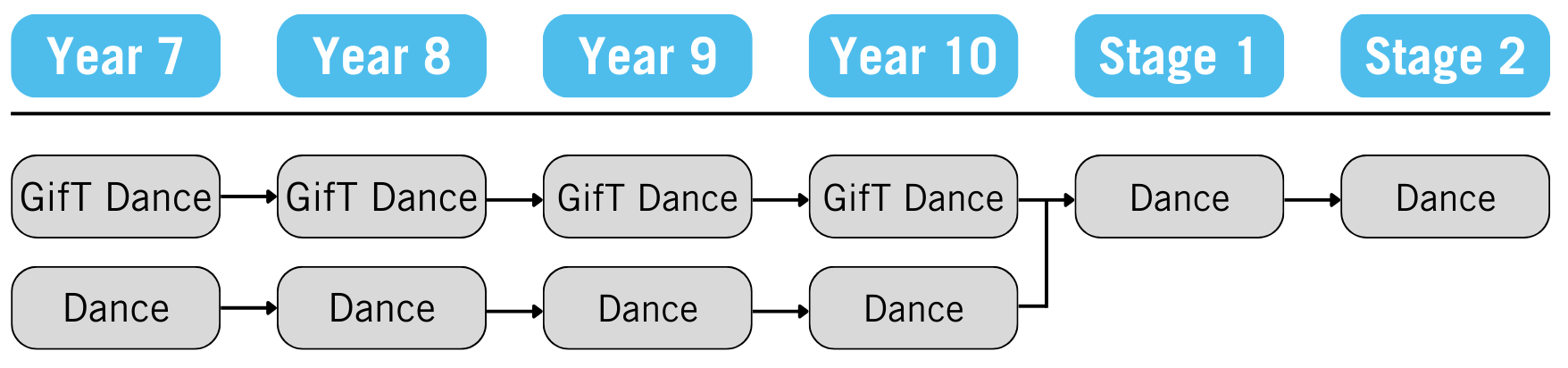
At SACE Stage 1, students study dance technique, composition, choreography, performance and the critical analysis of dance works.
At SACE Stage 2, students develop creative, technical and physical understandings and appreciation of dance as an art form.
Through the analysis of dance theatre performance, students learn about the choreography of local and international dance artists. They have the opportunity to explore a range of global dance traditions, influences and perspectives.
Dance
- Year Level: Stage 2
Description
At SACE Stage 1, students study dance technique, composition, choreography, performance and the critical analysis of dance works.
At SACE Stage 2, students develop creative, technical and physical understandings and appreciation of dance as an art form.
Through the analysis of dance theatre performance, students learn about the choreography of local and international dance artists. They have the opportunity to explore a range of global dance traditions, influences and perspectives.
Drama
- Year Level: Stage 1-2
Description
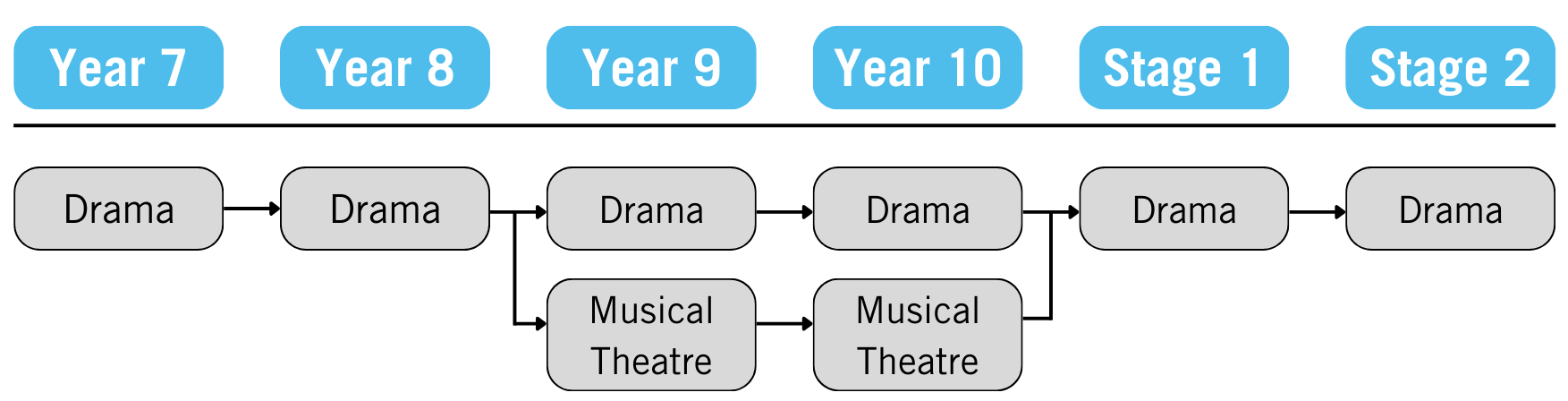
At Stage 1, students plan, rehearse and perform a dramatic work. They write and perform or design a production based on an investigation into a dramatic innovator or a style/s of drama. Students learn how to analyse their own dramatic and creative process, performance outcomes and the creative choices of others, through reflective writing. Assessment is based on these practical and written activities. At Stage 2, students work collaboratively to develop and sustain a theatre company, which guides the direction of their major production and other creative performance pieces throughout the course. To ensure the success of their theatre company, students may take on various roles either on or off stage. They analyse, reflect on and evaluate their own dramatic processes. They interpret and analyse dramatic works and innovators through performance tasks and written and multimodal responses. Their assessment is based on a combination of these practical and written tasks.
Drama
- Year Level: Stage 2
Description
At Stage 1, students plan, rehearse and perform a dramatic work. They write and perform or design a production based on an investigation into a dramatic innovator or a style/s of drama. Students learn how to analyse their own dramatic and creative process, performance outcomes and the creative choices of others, through reflective writing. Assessment is based on these practical and written activities. At Stage 2, students work collaboratively to develop and sustain a theatre company, which guides the direction of their major production and other creative performance pieces throughout the course. To ensure the success of their theatre company, students may take on various roles either on or off stage. They analyse, reflect on and evaluate their own dramatic processes. They interpret and analyse dramatic works and innovators through performance tasks and written and multimodal responses. Their assessment is based on a combination of these practical and written tasks
Music
- Year Level: Stage 1-2
Description
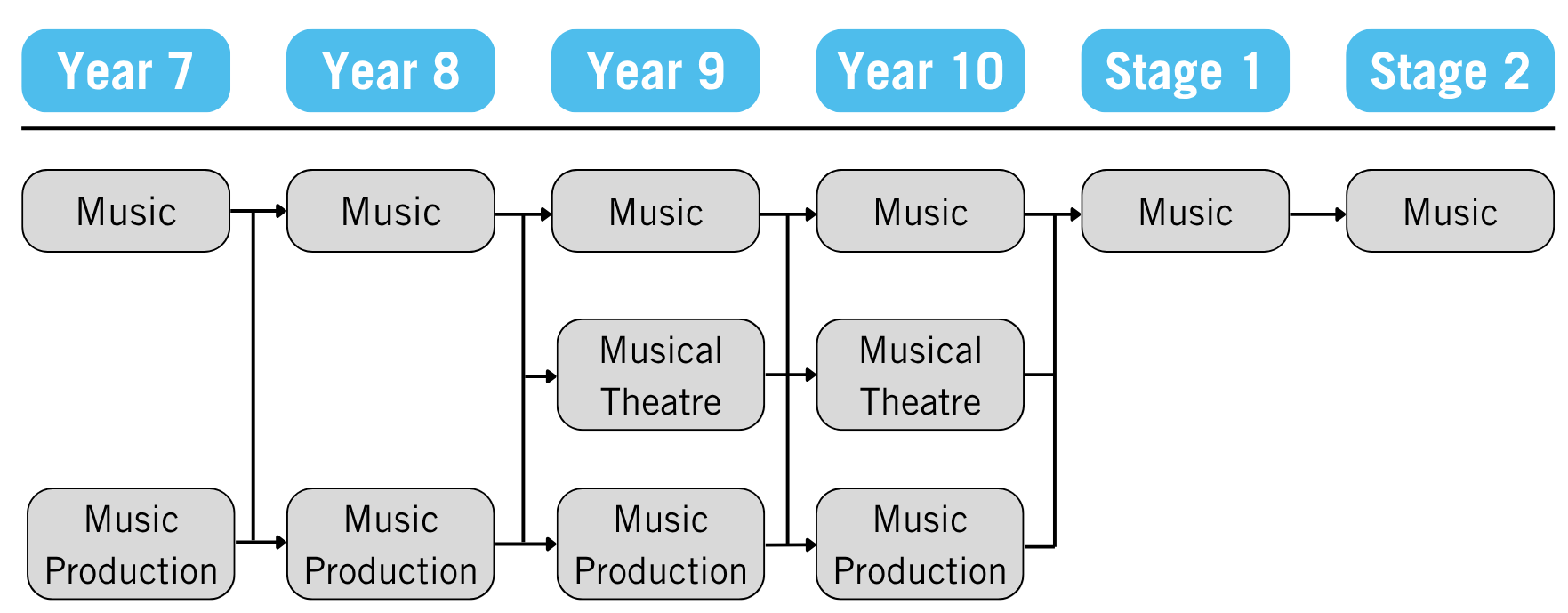
At Stage 1 Music students perform as soloists and in ensembles, and complete a composition, arrangements and reflection on their work. They can choose to focus on additional performances or more analysis and theory. Music Theatre/Voice can be chosen within this course.
At Stage 2 students can choose:
- a full-year 20-unit course from Music Studies, Music Explorations or Music Performance (Solo AND Ensemble)
- a full-year 10-unit Music Performance (Solo OR Ensemble)
- Music Studies or Music Explorations (20 units) AND Solo or Ensemble (10 units)
- Music Studies or Music Explorations (20 units) AND both Solo AND Ensemble (20 units)
Completing Solo or Ensemble without the other usually does not contribute towards ATAR. These choices are made in negotiation with their Music Teacher and through Course Counselling. Solo, Explorations and Ensemble (with a weekly lunchtime band) can be quite independent and can be completed offline by motivated and independent students.
Please note Music incurs an additional subject levy from year 8 to 12.
Students who choose to participate in Instrumental Music lessons will be charged the $110 per semester Music Subject Fee.
- If your young person participates in both Music and Instrumental Music, you will not be charged twice. The Music Subject Fee covers their participation in both.
- If your young person participates in Instrumental Music only and does not take a Music class, the Music Subject Fee still applies.
Music
- Year Level: Stage 2
Description
At Stage 1 Music students perform as soloists and in ensembles, and complete a composition, arrangements and reflection on their work. They can choose to focus on additional performances or more analysis and theory. Music Theatre/Voice can be chosen within this course.
At Stage 2 students can choose:
- a full-year 20-unit course from Music Studies, Music Explorations or Music Performance (Solo AND Ensemble)
- a full-year 10-unit Music Performance (Solo OR Ensemble)
- Music Studies or Music Explorations (20 units) AND Solo or Ensemble (10 units)
- Music Studies or Music Explorations (20 units) AND both Solo AND Ensemble (20 units)
Completing Solo or Ensemble without the other usually does not contribute towards ATAR. These choices are made in negotiation with their Music Teacher and through Course Counselling. Solo, Explorations and Ensemble (with a weekly lunchtime band) can be quite independent and can be completed offline by motivated and independent students.
Please note Music incurs an additional subject levy from year 8 to 12.
Students who choose to participate in Instrumental Music lessons will be charged the $110 per semester Music Subject Fee.
- If your young person participates in both Music and Instrumental Music, you will not be charged twice. The Music Subject Fee covers their participation in both.
- If your young person participates in Instrumental Music only and does not take a Music class, the Music Subject Fee still applies.
Visual Arts
- Year Level: Stage 2
Description
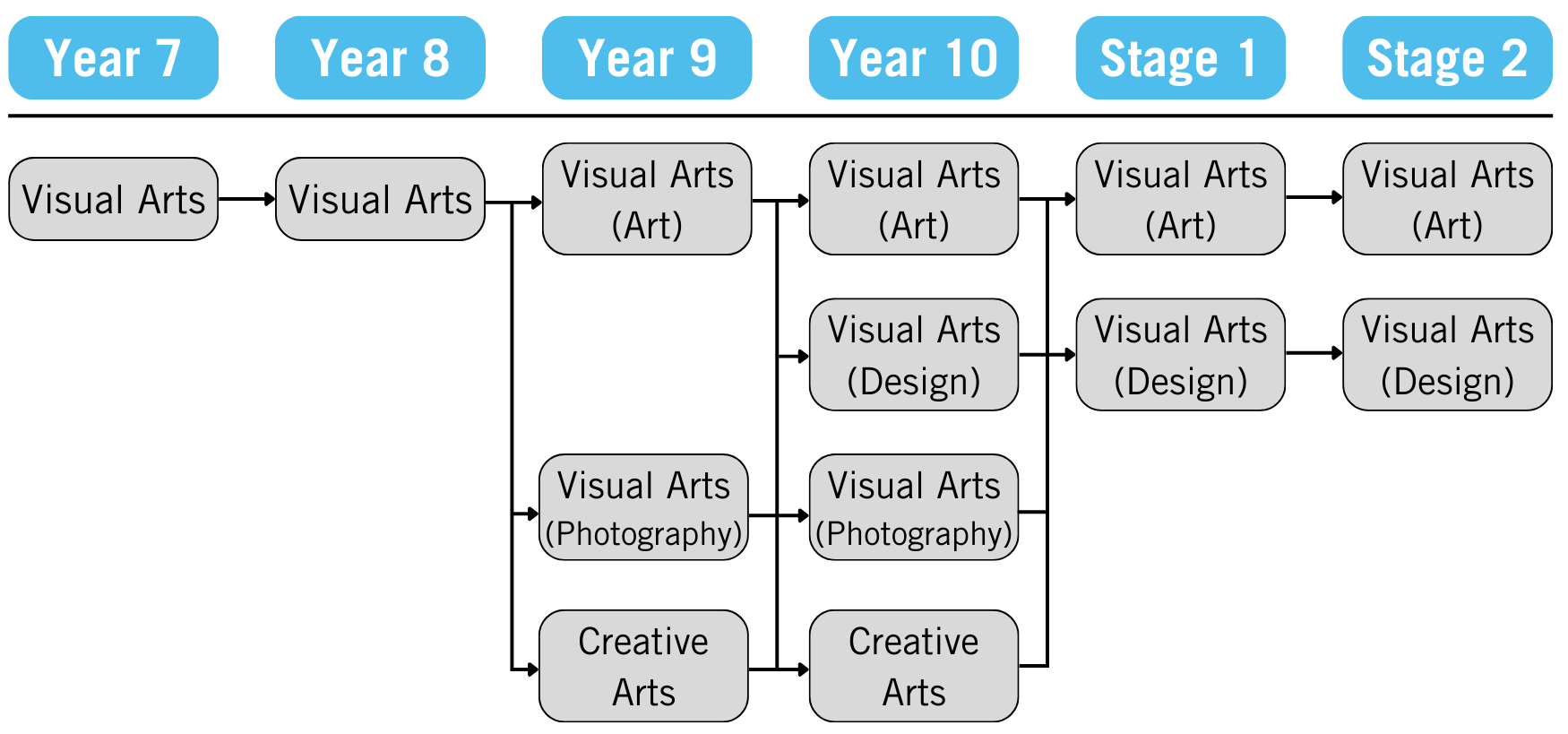
Art:
Students experiment widely with media and techniques to express an idea in the creation of art works. They research, analyse and interpret the work of artists and reflect on their social, cultural and historical contexts.
Design:
Students extend their ‘Design Thinking’ techniques to solve problems using sketches, diagrams, models, digital media, photographs, prototypes, etc., based on a self-directed design brief. They research, analyse and interpret the work of designers and reflect on their social, cultural and historical contexts.
Creative Arts:
The school offers students the opportunity to study Creative Arts within existing Stage 1 or 2 Arts classes. However, enrolment in these courses is individually negotiated with the teacher and Curriculum Leader. This strand of The Arts allows students to investigate, develop and produce arts products which cross over and/or combine Arts practice from any Arts field.